Chef Profile
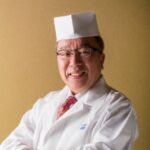
Chef Takashi Tamura (Japanese cuisine)
Not only does he show off his skills in the kitchen of Tsukiji Tamura, a long-established Japanese restaurant in Tsukiji, Tokyo, but he also travels around Japan giving lectures and cooking classes. He is a "Contemporary Master Craftsman" who is dedicated to spreading and passing on Japanese food culture through his TV appearances and writing activities
Tsukiji Tamura
Chef Profile
Tsukiji Tamura 3rd GenerationTakashi Tamura
Date of birth: November 30, 1957
He was born in 1957 as the eldest son of Tsukiji Tamura
After graduating from the Department of English and American Literature, Faculty of Letters, Tamagawa University in 1980, he entered the prestigious Osaka restaurant "Korabashi Kitcho" and after three years of training, he joined Tsukiji Tamura
The restaurant inherits the spirit and taste of "harmony of the five tastes" of its founder, Tamura Heiji, who said, "Food must have a good balance of the five tastes (sweet, sour, bitter, salty, and umami). Only then will customers find it delicious."
While demonstrating his skills at Tsukiji Tamura, the forefront of Japanese cuisine, he also devotes himself to passing on food traditions to the general public by appearing on television programs such as NHK, teaching at cooking schools, and publishing cookbooks
In 2007, when I was still a student, the first authentic Japanese meal I went to with my own money was a kaiseki meal at Tsukiji Tamura. I think it was 7,000 or 8,000 yen per person at the time. I was with a friend whose birthday was coming up, and every dish we had was incredibly delicious. I was amazed at how amazing a traditional Japanese restaurant can be, and it marked the start of a life of eating delicious food
Fate is a different thing
Right in front of me now is Tamura Takashi, the young owner of Tsukiji Tamura, demonstrating with each dish how to make the most of the ingredients, how to make dashi stock, and how to prepare simmered dishes
Thanks to the thorough training I received from my mother, who is an excellent cook, from a young age, I believe I can cook a variety of dishes, but every time I photograph Tamura Takashi's recipes, I am amazed at how ``new'' they are
On the Epi Recipe set, Tamura tries to teach cooking from a slightly different perspective than on NHK or other cooking shows
For example, if you're making a stew, you'll need a frying pan
Pour dashi over chopped vegetables and heat, then cover with an aluminum foil lid and wait until it boils, then immediately remove from heat. Once it has cooled a little, add a little seasoning, bring to a boil again, and remove from heat again. Add seasoning a little at a time each time it boils. After doing this, once the flavor is decided, add the finishing touch of soy sauce
"I never fail," she humourously recites a line she heard in a TV drama, while teaching us how to make delicious Japanese food in an ordinary household without fail, without using any special cooking equipment or seasonings, and "anyone can make it."
For example, oyakodon
Tamura takes out the chicken thighs and immediately starts frying the skin side in a frying pan
Place this on a tray and put it in the freezer
Once the chicken is half frozen to a nice consistency, use a knife to chop it into bite-sized pieces
This is the preparation
"This way it won't get squishy and you can cut it neatly to the same size."
Pour the dashi into a pot, add bite-sized pieces of chicken, bring to a boil and finish off the oyakodon
In fact, the effect of this pre-processing of the chicken is tremendous, as the browned skin gives the soup stock an exquisite aroma and flavor
It's so useful that we make small portions of it for each meal, and keep it in the freezer, so it can be used for not only oyakodon (chicken and egg rice bowls), but also hot pots and simple chicken stews
For example, soba noodles
"Hey, do you know the 10:3 rule?"
He has a very playful look on his face when he talks about a special recipe that not everyone would think of
Tamura suddenly took out the dried soba noodles, arranged them on a tray, and poured water on top
"Ten minutes like this."
After 10 minutes, the dried soba noodles will have absorbed the water and become soft
"Three minutes in boiling water"
The soft soba noodles were cooked in just three minutes
What's more, it has a texture that is just like fresh noodles
Tamura gave us a smug look at our surprised faces
For example, radish
At Tsukiji Tamura, we never waste any ingredients
To make furofuki, cut the thick skin of a radish into thin strips and dry it in a colander
It's homemade dried daikon radish
When using it, you soak it in water and then slowly add it to the pot, and it's incredibly delicious
Thanks to this, I no longer throw away radish peels
Tamura's recipes are currently filmed per day, with three different ingredients used and 10 dishes made from each ingredient
Thirty dishes will be made from scratch, and each cooking method will be surprising, inspiring, and "new."
Yet, they don't use any complicated methods that you wouldn't use at home
While cooking, I thought, "Oh, we don't do these tedious things at home. We have to start again, start again."
At EpiRecipe, we wanted to name this delicious, authentic Japanese cuisine, "Tamura Takashi's Authentic Japanese Cuisine That You Can Make Too."
I hear that Tamura's hobby is model trains
He is very dexterous, and the last time he photographed a vessel, the edge of which had been chipped and he was unable to use it for the photoshoot, he had it beautifully repaired with gold paint by the time of the next photoshoot
Tamura also writes essays
This essay is actually excellent
About cooking. About training
It's not only an interesting cookbook, but also a fascinating and humorous personality
Above all, it is clear that the first generation was a "grandpa's boy" who loved him very much
I highly recommend his masterpiece, "Hidden Knife."
Filming always takes place in the kitchen on the second floor of Tsukiji Tamura
On one side of the spacious kitchen, there are three tables and a large rice cooker
While we were preparing to film the recipes, young chefs were eating their staff meal behind us
The chefs eat from the same oven, live together under the same roof,
He aims to become a top chef
Each one is fresh and incredibly delicious
Authentic Japanese cuisine that you can make too
I would definitely encourage you to give it a try
I highly recommend that you visit Tsukiji Tamura to try Tamura's Japanese cuisine
In 2010, he received the Minister of Health, Labour and Welfare's "Contemporary Master Craftsman" award. He is also a master chef at the Japan Culinary Institute
His publications include "Essay: Hidden Knife" (Hakusuisha), "Basics of Japanese Cuisine" (Shinsei Publishing), and many others
On December 22, 2020, Takashi Tamura passed away from acute heart failure (aged 63)
EpiRecipes offers a whopping 1,150 recipes
In the kitchen on the second floor of Tsukiji Tamura, we prepare all of our dishes without leaving anything behind
I was shown and recorded
After cooking, we all had a meal together, which was a really fun and delicious time
Thank you so much for all the recipes and your love for ingredients
Tsukiji Tamura Building is currently being demolished and rebuilt (scheduled to reopen in 2023)
Until the restaurant is completed, the fourth-generation owner, Yuji Yoda, is striving to provide better food, mainly in Hachinohe
He is currently undergoing training
Article: Ryuzoji Temple Crow